

In this article, I will introduce strategies for overcoming shopping addiction.
This article is recommended for people who:
Effects of reading this article:
This article is based on the content of this book.
To make the content easier to understand, I’ll introduce the content in a conversational format with author Luke Burgis.
 Ichi
IchiHello, I’m Ichi. Thank you for having me today.
 Luke
LukeHello, Ichi. I’m Luke. Likewise, nice to meet you.
IchiToday, I’d like to inquire about methods to quit unnecessary shopping.
LukeOf course!
From birth to death, we’re always desiring something, aren’t we?
For example, wanting to travel, wanting to be wealthy, desiring high-end bags, cars, or watches, wanting a partner, wanting to live in a luxury apartment, or desiring respect in high positions.
IchiThat’s true. I have a lot of things I want too.
Right now, I want a Rolex.
LukeRolex is a good watch, isn’t it?
By the way, why does Ichi want a Rolex?
IchiHmm. I’m not entirely sure.
I just found myself wanting it.
LukeI see.
Is it because people around you want a Rolex too?
IchiHuh? Come to think of it, yes!
My friends were talking about wanting a Rolex, and as I listened, I found myself wanting one too.
LukeActually, Professor René Girard of Stanford University writes in his book “Mimetic Desire” that most of the things we desire are mimetic.
IchiSo, because people around me want it, I also end up wanting it?
LukeThat’s right.
When people see someone desiring a Rolex on social media, in town, or at work, they start wanting it too.
IchiSo, does that mean I don’t really want a Rolex?
LukeWell, you would certainly feel excited and happy to obtain it.
However, the likelihood of getting bored quickly is high.
Because that desire stems from imitation of others.
IchiIn that case, what is my true desire?
LukeThat’s important.
Understanding it makes it easier to lead a fulfilling life.
I’ll explain more about that in detail.
You shop to imitate someone else
 Luke
LukeActually, most desires have models.
IchiMost desires have models?
What do you mean?
LukeAbout 80% to 90% of the things we desire are triggered by someone else’s actions.
So, there’s inevitably a model who made us desire that.
For example, have you ever seen clothes or shoes worn by your friends and felt like you wanted them too?
IchiYes, often.
LukeThat’s because you imitated your friends’ desires.
Such occurrences happen because humans are creatures that excel at imitation more than anything else in this world.
IchiSo, humans are beings that mimic.
LukeThat’s right.
We mimic language, expressions, hairstyles, walking styles, attire, and behaviors appropriate for various situations from infancy as we grow.
Similarly, we also imitate others’ desires, such as what they want, whom they like, desired professions, qualifications, careers, fame, and occupations.
IchiSo, when the feeling of wanting something arises, it’s mostly because we’re imitating someone who wants it?
LukeExactly.
When we see someone owning a pet, we might want one too.
Or when we see someone wearing a Rolex or someone who desires it, we might also start wanting a Rolex.
IchiSo, there’s a model who made me want a Rolex.
LukeThat’s right.
That’s why such desires are shallow, and even if fulfilled, they don’t bring much happiness.
IchiI see.
Maybe I should stop wanting a Rolex.
LukeIn my book, I refer to desires born from imitating others as “shallow desires.”
About 80% to 90% of our desires are usually shallow desires.
So, remember that in most cases, desires have models.
Imitating others’ desires breeds unnecessary competition
 Luke
LukeOur next topic is “Imitating others’ desires breeds unnecessary competition.”
IchiUnnecessary competition?
LukeYes, as I’ve explained, people tend to desire what others want.
This often leads to competition and conflicts over the same things.
For example, if a friend likes someone, you might become aware of that person and develop feelings for them too.
Then, you end up in a rivalry with your friend.
And even if you win that competition and start dating the person you were after, you might realize you’re not that into them.
That’s because you only valued them because your friend liked them.
IchiI wouldn’t want to be in that situation…
LukeThis applies not only to romantic relationships but also to possessions, careers, contests, and ambitions.
Everyone aims for jobs at big corporations, so you also want to work for one.
Everyone aims for prestigious universities, so you also want to attend one.
When you desire what others desire, unnecessary competition arises, and even if you achieve it, you won’t find true happiness.
Failing to realize this can lead to spending a lot of time pursuing shallow desires
IchiSome people end up pursuing careers like becoming a doctor even though they don’t really want to.
LukeExactly.
Remember that imitating others’ desires leads to unnecessary competition.
Cherish your inner 10% intense desires
 Luke
LukeNext up is “Cherish your inner 10% desires.”
As I’ve explained, about 80% to 90% of our desires are imitations of others.
They’re superficial and fleeting, influenced by our surroundings.
On the other hand, the 10% intense desires originate from our core and remain unaffected by external changes, providing enduring happiness.
IchiSo, these desires remain unchanged even after decades?
LukeExactly.
However, desires like owning a luxury car or buying an expensive watch are shallow.
Despite acquiring them, the feeling of satisfaction is temporary and quickly fades.
Prioritizing these shallow desires won’t lead to genuine happiness.
Therefore, rather than being misled by the 80% to 90% shallow desires, pursuing the 10% intense desires from within oneself leads to a fulfilling life.
But, this seemingly simple task is quite challenging.
IchiWhy is that?
LukeBecause nowadays, we’re inundated with a massive amount of information through social media.
This results in countless shallow desires emerging within us every day.
Recognizing them is quite difficult for us.
IchiIf this continues, it becomes increasingly challenging to recognize our own intense desires.
How to distinguish between shallow and intense desires
 Luke
LukeLet’s talk about how to distinguish between shallow and intense desires.
Let me teach you four practical methods that are easy to implement.
IchiPlease, go ahead.
1. Identify the models of your desires.
LukeFirstly, identify the models of your desires.
As I mentioned earlier, shallow desires always have a model behind them.
So, it’s essential to think seriously about who influenced your desire for a Rolex, for example.
IchiThat’s interesting.
LukeUpon reflection, you’ll likely realize that someone influenced that desire.
It could be an influencer you follow on social media or a friend.
If you can pinpoint someone, it’s likely a shallow desire.
IchiI see.
From now on, when I want something, I’ll write it down and think about it.
LukeThat’s a great idea!
It allows you to objectively understand your feelings.
Once you’ve identified the model, the next step is to disconnect from their influence, perhaps by muting them on social media.
Creating some distance from the model helps to avoid being swayed by shallow desires.
2. check the persistence of your desires
LukeThe second method is to check the persistence of your desires.
IchiPersistence?
LukeYes, it’s about determining if the desire lasts over time.
Shallow desires typically disappear quickly.
On the other hand, intense desires from within tend to persist throughout your life.
For example, people who are good at saving money often wait a month before purchasing something they desire.
Often, by that time, the desire has faded.
3. Creating time alone to deepen self-understanding
LukeThe third method involves creating time alone to deepen self-understanding.
IchiDeepen self-understanding?
LukeWhen surrounded by various people and information, it’s challenging to think deeply.
Therefore, creating time alone to reflect on yourself is crucial.
Many people experience a significant shift in their life perspective when faced with a serious illness or a period of solitude in a hospital.
This often leads to a realization of the intense desires they truly want to fulfill.
IchiIndeed.
We often hear such story.
LukeI think it’s rare for people to have the exact same experiences.
However, without taking the time to calmly think about what you want or what you want to achieve, you’ll end up being tossed around by shallow desires.
IchiHow do you recommend thinking alone?
Luke
It’s effective to think in an environment free from social media and the influence of others.
For example, going to a favorite café and turning off your phone to think would be a good idea.
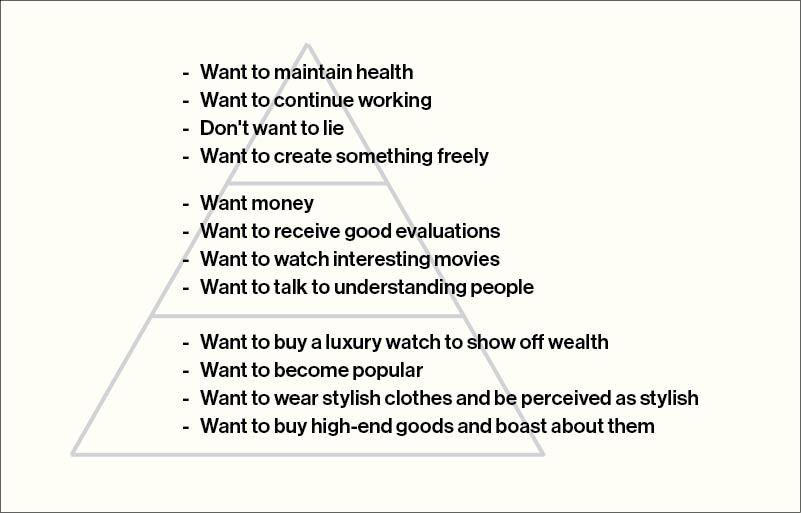
4. Clarify the hierarchy of your desires
LukeThe fourth method is to clarify the hierarchy of your desires.
Our desires may seem equal, but they actually have a clear hierarchy.
As I’ve explained, most desires are imitations of others, while a small percentage comes from within.
It’s beneficial to write down this hierarchy when you’re in a calm state.
This helps you recognize the importance of each desire.
For example, it might look something like this.
 Luke
LukeIf you’re overwhelmed by shallow desires, you might not accurately identify what you truly desire.
However, even if you make a tentative list, it helps.
This way, when a desire arises, you can understand which level it belongs to.
If it’s lower down, it may not need fulfilling.
IchiIt’s good to think like this, as it helps bring back a sense of calm.
LukeMany people don’t have a hierarchy for their desires; everything seems equally important.
It’s like every sentence in a book is highlighted.
In this state, it’s challenging to know which desires are essential.
However, by clarifying your significant desires, you reduce the likelihood of making mistakes in your choices.
With age, comes understanding of intense desires
 Luke
LukeFinally, as you grow older, you become better at distinguishing between intense and shallow desires.
IchiIndeed. I’ve noticed that I’ve been able to recognize what I truly desire after crossing my 30s.
LukeThat’s true for everyone.
In youth, we’re often driven by strong desires like wanting to be wealthy or famous.
But as we age, many of these intense feelings from our youth tend to fade away.
IchiI can relate to that.
In my 20s, I used to think a lot about climbing the career ladder and earning a lot of money.
But now, those feelings have weakened.
LukeThat’s an insightful realization.
It’s not because you’ve realized you can’t attain what you want, but rather, it’s because you’ve become more aware of your true desires through your experiences.
For instance, even if you once thought you wanted a carefree life without work in your youth, as you age, you might find yourself wanting to work continuously.
Therefore, as people age, they often tend to seek out intense desires.
Of course, there are those who continue to pursue shallow desires even as they age…
IchiThere are also people who challenge themselves with new things as they get older.
And it seems like many of them are quite happy.
Recap
Here’s a summary of today’s content:
Mechanism of Desire
Most desires are imitations of others. Imitating others’ desires leads to unnecessary competition.
Types of Desires
There are two types – shallow desires and deep desires.
Shallow desires are fleeting and influenced by the environment, while deep desires stem from within, providing lasting fulfillment.
Importance of Deep Desires
Prioritizing the 10% of deep desires that originate from within leads to a more fulfilling life.
Ways to distinguish between shallow and deep desires include:
a. Identifying the models of desire
b. Checking the sustainability of desires
c. Spending time alone to deepen self-understanding
d. Clarifying the hierarchy of desires
Age and Understanding
With age comes the ability to distinguish between shallow and deep desires.
That concludes the content for this article!
Thank you for reading until the end, That’s all for this review.
If you have any questions, feel free to send me a DM or leave a comment.
Sayonara