Monday comes, and you go to work.
Friday comes, and you think, “Finally, the weekend.”
On your days off, you spend time with friends or watch YouTube or Netflix.
It’s not that you’re struggling to make ends meet.
And yet, on Sunday evenings or just before going to bed, a thought quietly crosses your mind.
“What am I working so hard for?”
“Is this really how my life is going to end?”
Have you ever felt that way?
I certainly have.
At the time, I was working as an HR consultant for the Deloitte Group. Thanks to the support of so many people around me and the trust of my clients, I was fortunate enough to achieve the highest sales record in the company’s history.
Back then, I truly believed this:
“If I achieve great results, I’ll finally feel fulfilled.”
But reality turned out to be different.
Reach one goal, and another one appears.
Earn recognition, and you start chasing the next one.
Unfortunately, life doesn’t roll the end credits when you clear a level.
Before I knew it, I had been running in an endless game.
“Why do I still feel unfulfilled, even though I’m working so hard?”
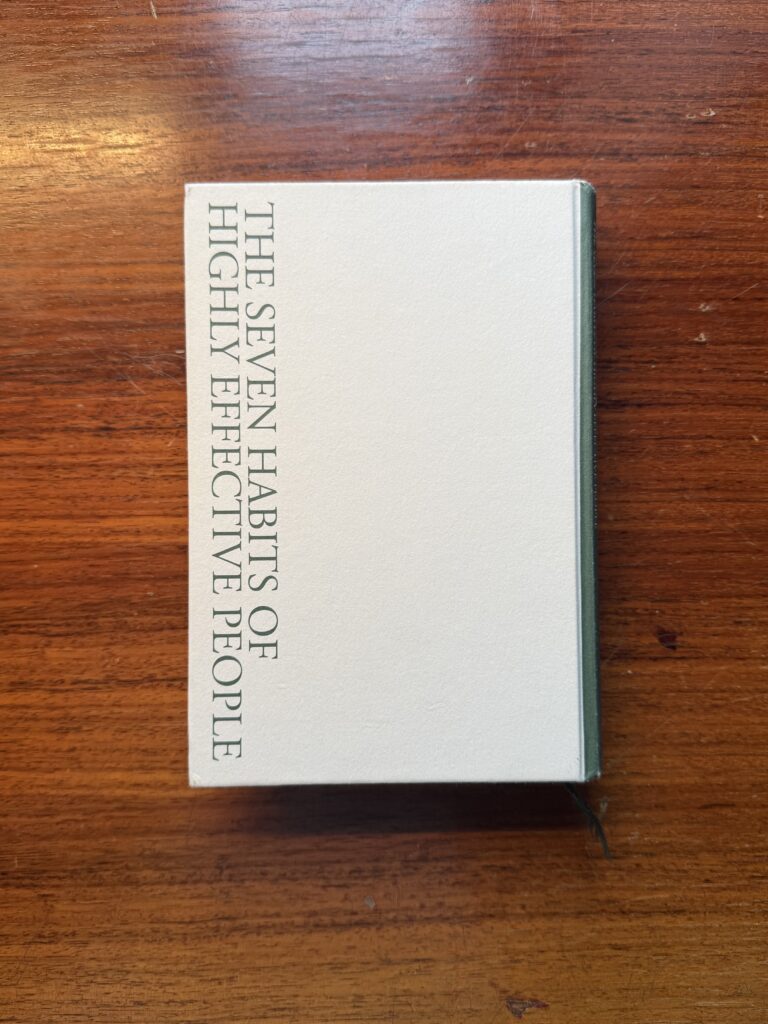
The book that gave me the answer was The 7 Habits of Highly Effective People.
Why Life Feels Empty: Because You’re Not Living Your Own Life
The biggest realization I had after reading The 7 Habits was this:
The reason we feel unfulfilled isn’t because we don’t have goals.
The real reason is that
we haven’t chosen our own purpose in life.
When we don’t decide our own purpose, we naturally begin living according to other people’s expectations and standards.
For example, when many people start their first job, they simply think,
“I’m just happy to have a stable job.”
But once work begins…
Your boss says something unreasonable.
You compare yourself with your coworkers.
You feel frustrated when your efforts aren’t recognized.
Before long, your goal quietly changes into something else.
“I’ll prove them wrong by succeeding.”
“I want to get promoted and finally be recognized.”
In How to Win Friends and Influence People, Dale Carnegie wrote that people have a deep desire to feel important.
So there’s nothing wrong with wanting recognition.
The problem begins when that desire quietly becomes your purpose in life.
Getting promoted.
Earning more money.
Being admired by others.
None of these are bad goals.
But if they come from comparison instead of your own values, achieving them won’t make you feel fulfilled.
You reach one goal…
Then immediately begin looking for the next one.
Before you realize it, you’re climbing
a mountain someone else chose for you.
You may climb higher and higher.
But was that ever the mountain you truly wanted to climb?
This game has no final boss.
No ending.
That’s why every achievement simply leads to another goal.
Looking back, that’s exactly why I never felt fulfilled.
The Most Important Habit: Be Proactive
As the title suggests, The 7 Habits introduces seven habits.
Every one of them is valuable.
But if I had to choose the most important one, it would be the very first:
Be Proactive.
The reason is surprisingly simple.
Without being proactive,
you can’t decide your own purpose,
and you can’t move toward it.
The book is intentionally structured this way.
Habit 1: Be Proactive.
Habit 2: Begin with the End in Mind.
Habit 3: Put First Things First.
In other words,
proactivity is the foundation upon which the other six habits are built.
You could also say this:
It’s taking the steering wheel of your life back into your own hands.
Everything begins there.
Being Proactive Means Taking Back the Steering Wheel
Imagine this.
Your boss gives you an unreasonable order.
You think,
“Nothing will change unless my boss changes.”
Or perhaps you have a friend who constantly tries to one-up you.
Yet you continue the friendship simply because,
“We’ve known each other forever.”
Or you scroll through social media and think,
“I’m still not good enough.”
These situations happen to everyone.
Of course, you can’t change your boss.
You can’t change your friend.
But The 7 Habits asks a simple question.
“Can you choose how you respond?”
You can’t change your boss.
But perhaps you can change how you respond.
You can’t change your friend.
But perhaps you can choose how you interact with them.
Being proactive doesn’t mean solving everything by yourself.
It means
focusing less on the scenery you can’t change, and more on the steering wheel you can still turn.
To me, this idea goes far beyond work or relationships.
Once you begin taking back the steering wheel,
you slowly begin asking yourself,
“Where do I really want to go?”
And that question eventually leads you to your own purpose in life.
I Remembered My Childhood Dream
After reading The 7 Habits, I asked myself,
“What do I really want?”
The answer surprised me.
I remembered a dream I had carried since childhood.
I wanted to live overseas.
I wanted to speak English.
The dream had never disappeared.
It had simply been tucked away, like an old photo album hidden in the back of a closet.
Back then, I was focused only on achieving results.
But eventually I realized something.
Even outstanding performance at work doesn’t decide your life.
For the first time, I stopped and asked myself,
“Why did I want to get promoted in the first place?”
The answer wasn’t a higher position.
It wasn’t a bigger salary.
It was the dream I had always had—to live abroad.
At the time, my English was almost nonexistent.
Even so, because it was my own goal, I studied English for about three years, every single day.
Of course, I didn’t do it alone.
I was supported by my family, friends, coworkers, clients, and many others along the way.
Thanks to their encouragement, I was eventually able to study abroad in Australia.
But looking back,
the happiest day wasn’t the day I arrived there.
It was the day I realized my English had improved.
The day I felt one step closer to my dream.
More than reaching the destination,
it was the feeling of walking a path I had chosen for myself that truly fulfilled me.
But Becoming Proactive Isn’t Easy
By now, you might be thinking,
“I understand the idea… but it’s hard.”
I agree.
Reading The 7 Habits is easy.
Living it is much harder.
So I started with something small.
I changed the words I used.
Whenever I caught myself thinking,
“There’s nothing I can do because it’s someone else’s fault.”
I tried asking instead,
“Given this situation, what can I do?”
It was only a small change.
But in those moments,
I felt like I had taken back the steering wheel of my life.
Proactivity isn’t something you master overnight.
I believe it’s built through small choices we make every single day.
Which Version Should You Read First?
To be honest, the original The 7 Habits of Highly Effective People is not an easy read.
The content is outstanding, but it’s filled with many examples, making it a fairly long book.
If you’re already comfortable reading books, I highly recommend the original.
▶ The 7 Habits of Highly Effective People
On the other hand, if you simply want to understand the core ideas first, I recommend The 7 Habits of Highly Effective Teens.
Despite the title, it’s just as valuable for adults.
Because it uses everyday school-life examples, it’s much easier to picture what being proactive actually looks like.
The author, Sean Covey, doesn’t simply explain his father’s ideas.
He also acknowledges what many readers feel.
“I understand the ideal—but living it every day is difficult.”
He offers practical ways to put those ideas into action.
Personally, starting with this book made it much easier for me to apply the principles of The 7 Habits to my own life.
▶ The 7 Habits of Highly Effective Teens
Conclusion | The 7 Habits Is a Map for Life
In this article, I focused on what I believe is the most important principle in the book:
being proactive.
But this is only the beginning.
The book also explores
your purpose in life,
relationships,
Win-Win thinking,
how to truly understand others,
and how to continue growing throughout your life.
To be honest, I didn’t fully understand it the first time I read it.
Each time I revisit it at a different stage of life, I discover something new.
That’s why I don’t think this is a book you read once and put back on the shelf.
It’s a book you return to whenever you lose your way—
a map you unfold again and again throughout your life.
If you’ve been thinking,
“I’m working hard, but something still feels missing.”
I hope you’ll give this book a chance.
It won’t hand you all the answers.
But I believe it will help you ask the right questions—and guide you toward a life that you choose for yourself.